

Published on 17.09.2026 г.
Western Balkan Companies in North Macedonia: €1.1 Billion in Revenue, but Not the Same Level of Stability
Companies in North Macedonia owned by legal entities and individuals from the Western Balkans generate over €1.1 billion in revenue, employ more than 8,300 people, and produce over €65 million in prof...
Western Balkan Companies in North Macedonia: €1.1 Billion in Revenue, but Not the Same Level of Stability
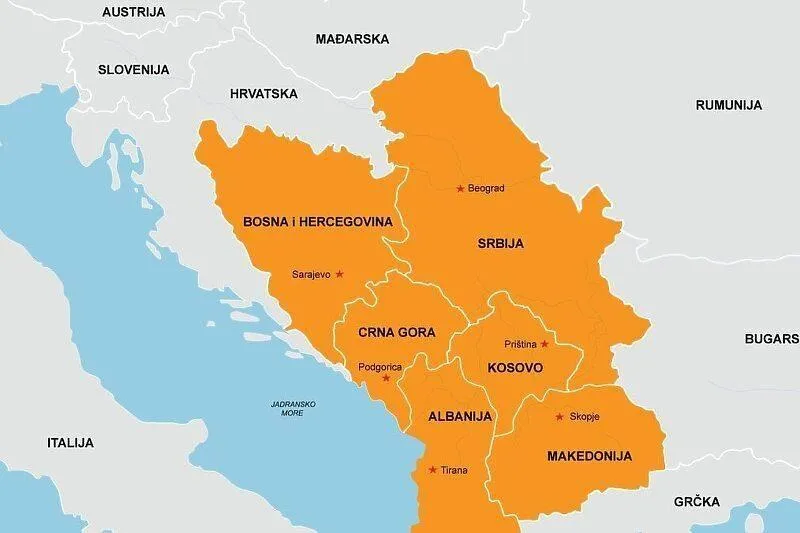
Companies in North Macedonia owned by legal entities and individuals from the Western Balkans generate over €1.1 billion in revenue, employ more than 8,300 people, and produce over €65 million in profit. This clearly positions them as a segment with tangible economic impact. The majority of this activity originates from Serbia, Kosovo, and Albania, which together account for more than 70% of total regional presence.
However, this raises a fundamental question: does strong regional volume automatically translate into a reliable business profile, or do high revenues mask varying levels of financial stability?
Volume Is Concentrated, but Quality Is Not Equal
Serbia holds the dominant position, with 503 companies generating €490 million in revenue, making it by far the most influential regional player in the Macedonian market. This is not only relevant in terms of scale, but also from an integration standpoint, as Serbian capital is no longer peripheral—it is embedded within the country’s business ecosystem. When a single market leads both in number of companies and total revenue, its impact goes beyond investment and becomes systemically relevant.
Kosovo and Albania, on the other hand, together generate over €520 million in revenue, which at first glance signals strong market presence. However, this is where deeper analysis becomes critical. The average credit rating of these companies falls within the E category, indicating higher risk despite the strong volume. This suggests that while activity is real and revenues are substantial, financial stability is weaker and dependency on operational cash flow is higher. In such a structure, scale creates the perception of strength, but the quality behind that strength remains uncertain.
Smaller Segments Can Signal Greater Stability
A particularly interesting case is Bosnia and Herzegovina. Although companies from BiH operate at a significantly smaller scale—with 44 companies generating €63 million in revenue—they demonstrate the strongest average credit rating, positioned in the DE category. This highlights an important insight: stability is not the same as size. A smaller market footprint can often indicate better control, more moderate growth, and healthier financial structures—factors that can be more valuable to business partners than high revenue without sufficient underlying security.
Montenegrin companies have the smallest presence, with 36 companies and just €11 million in revenue. Their role in the overall structure is limited, contributing neither major risk nor major potential, positioning them as more peripheral than strategic players.
Salaries Reveal Different Business Models
When average salary per employee is introduced into the analysis, the picture becomes even more nuanced. Albanian companies lead with an average salary of €935, followed by Serbian companies at €720, BiH at €595, Montenegro at €520, and Kosovo at €395.
These differences should not be interpreted merely as variations in labor cost, but as indicators of differing value creation models, sector focus, and organizational structures.
However, higher salaries do not automatically imply greater stability. If they are not supported by strong revenue per employee, sustainable margins, and controlled leverage, they may signal financial pressure rather than strength. Conversely, lower salaries—such as in the case of Kosovo—may indicate a more operational, labor-intensive model where volume is driven by workforce rather than productivity.
Key Insights
What Lies Behind the Numbers
The key takeaway from this analysis is that regional presence should not be evaluated solely through revenue, company count, or employment figures. The real value lies in how that activity is generated, how sustainable it is, and what level of risk is embedded in the financial structure.
This is where a hidden pattern emerges: large numbers can easily create a perception of trust, even when underlying stability varies significantly.
In practice, this means that two companies with similar revenue levels can have entirely different risk profiles. One may be liquid, profitable, and stable, while the other operates under constant financial pressure, with weaker creditworthiness and higher dependence on short-term inflows. Risk, therefore, is not a function of size, but of financial quality—an aspect often overlooked when focusing only on aggregated figures.
What This Means for Companies
For Macedonian businesses, the message is clear. When evaluating regional partners, it is not enough to consider revenue size, workforce, or market presence. What matters more is whether that scale is supported by solid financial fundamentals—strong creditworthiness, stable liquidity, and sustainable leverage.
This also creates a strategic opportunity. Companies that apply deeper analytical evaluation when selecting partners will make better decisions, reduce risk exposure, and identify more reliable collaborations—while others remain focused only on surface-level metrics.
In an increasingly interconnected regional market, the biggest risk is confusing scale with quality, and the greatest advantage is recognizing the difference in time.
Conclusion
Western Balkan companies in North Macedonia bring real capital, employment, and economic momentum. However, their impact is not one-dimensional. Behind a unified regional narrative, there are fundamentally different models of stability, productivity, and risk.
The numbers show presence and strength—but true business reliability begins only when we understand what lies beneath them.
Biznis Mreza – Business Intelligence Platform by Target Group
The data and information published on this page are the property of Biznis Mreza and are intended for informational purposes. Unauthorized use and distribution of the content is prohibited, and any reference to the published information must clearly credit Biznis Mreza as the source.
Related analyses

5 Costly Mistakes When Choosing a Business Partner
Choosing a business partner rarely appears to be a risky decision at the moment it is made. However, this is often where the most expensive problems begin—through uncollected receivables, weakened liq...
Read more
Labor Market in North Macedonia 2025: 433,000 Positions and an Economy Driven by Volume, Not Value
In 2025, the labor market in North Macedonia is defined by scale, with over 150,000 job postings and 433,000 demanded positions, providing one of the most detailed insights into actual workforce deman...
Read more